
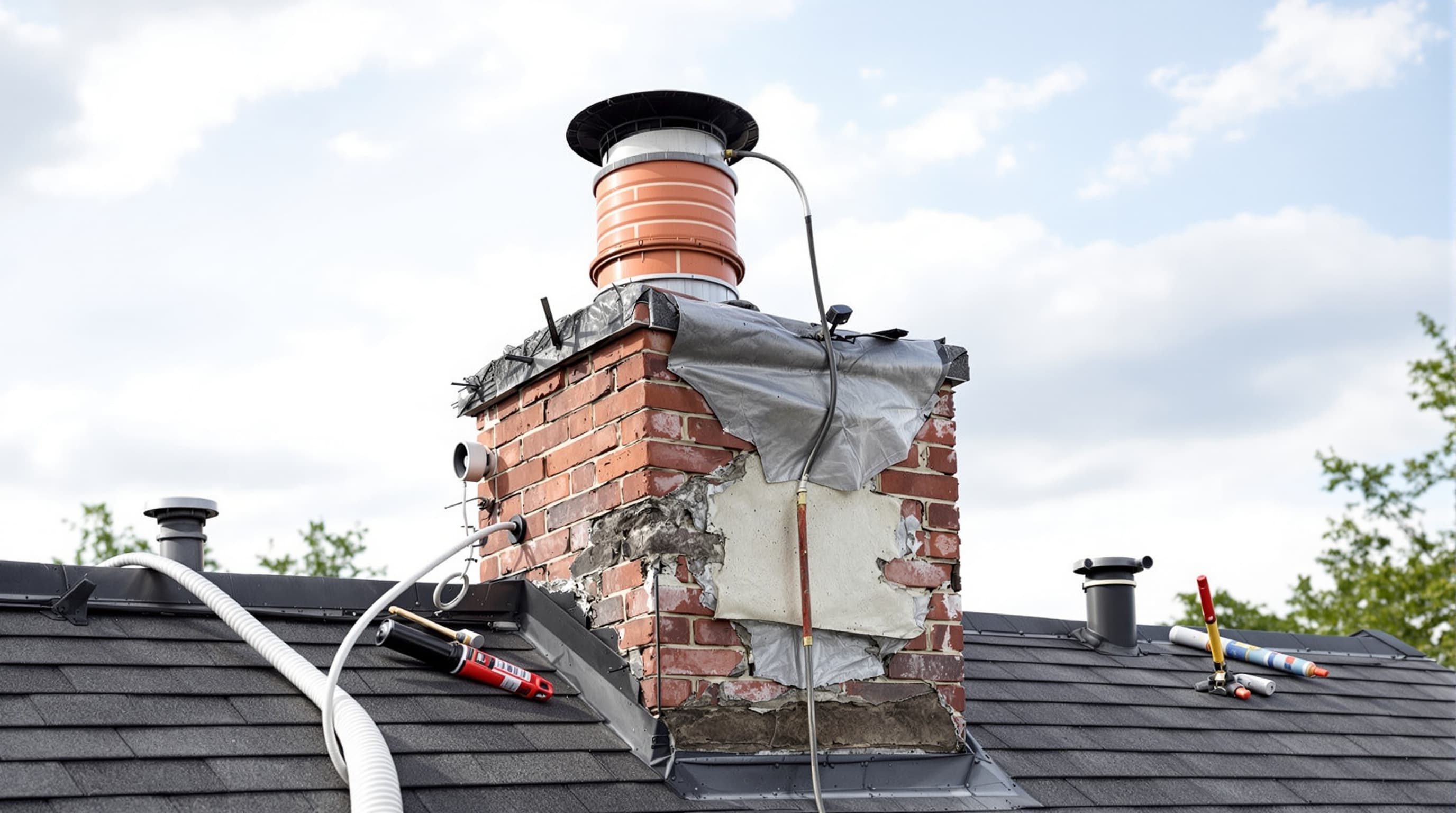
# Why the liner matters
Your chimney's job is to carry hot combustion gases safely out of your house. The liner is the thing actually doing that job — the masonry around it is structural, but the liner is the flue passage that contains the heat, corrosive acids, and creosote.
If the liner fails — cracks, gaps, or corrodes — those gases can escape into your walls and attic. That's how house fires start. That's how carbon monoxide builds up in living spaces. The liner is the safety-critical layer.
On Long Island we see three liner types, each with different use cases.
Clay flue tile (the legacy default)
Almost every Long Island chimney built before 1990 has a clay flue tile liner. Clay tiles are fired ceramic, typically 2-foot sections, stacked vertically with mortar joints between them inside the masonry chimney shaft.
Why it was used: cheap, readily available, fire-resistant, decent performance for wood-burning fireplaces.
The problem: clay tiles crack. Thermal shock from a hot fire, especially a chimney fire or a flue exposed to freeze-thaw water damage, causes clay to split. Once cracked, the liner is no longer a sealed passage — gases can move between the flue and the masonry, and eventually into the house.
Clay tiles also corrode over decades when exposed to oil-burning furnace flue gases. Oil combustion produces sulfuric acid as a byproduct. This eats through clay tile mortar joints and crumbles the tile itself. Long Island has a lot of 1950s-60s homes with oil furnaces that vented into clay-tile chimneys — and a lot of those liners are now non-functional.
When clay still works: if a visual and camera inspection shows the tiles are intact, joints sealed, no cracks — clay is fine. We don't replace working clay liners just because they're old.
Cost to replace clay tiles: rarely done. If the masonry chimney is otherwise sound, we bypass failed clay tiles by installing a stainless steel insert inside the existing shaft. That's the modern approach.
Stainless steel (the Long Island standard for relining)
When a clay liner fails and needs to be replaced, 95% of our Long Island jobs install a stainless steel liner. These are flexible or rigid stainless tubes (typically 316Ti or 904L alloy) that drop down the inside of the existing chimney.
Why stainless works:
- Corrosion-resistant (handles wood, gas, and oil fuel byproducts)
- Sized precisely to the appliance — better draft, less creosote
- Insulated with ceramic blanket to keep flue gases hot (prevents condensation)
- Comes with a lifetime warranty from most major manufacturers
The two grades we use:
- 316Ti: standard-grade for wood and gas. Lifetime warranty from most manufacturers (Rockford, Forever Flex). Used for maybe 70% of Long Island wood-burning relines.
- 904L: premium corrosion-resistant alloy for oil-burning appliances, high-efficiency condensing boilers, or any system where the flue gases contain sulfuric acid. More expensive but mandatory for oil-fired systems.
Cost on Long Island: $2,400-$5,800 installed, depending on chimney height, liner size, and whether insulation is required (it usually is).
Install time: most single-flue relines are done in a single day. Double-flue or tall chimneys may take two.
What you get in writing: manufacturer lifetime warranty on the liner itself (parts), plus our 5-year labor warranty.
Cast-in-place (HeatShield, Smoktite, etc.)
A third option uses a specialized refractory cement that's sprayed or cast into the existing flue, bonding to and sealing whatever condition the original clay tiles are in. Brand names you'll see: HeatShield, Smoktite, Golden Flue.
When it makes sense:
- The existing clay tile liner has minor cracks but is otherwise intact
- The chimney geometry is unusual (bends, small openings) that make a stainless insert impractical
- Budget is significantly lower than a full stainless reline
Limitations:
- Cast-in-place liners don't have the same lifetime warranty as stainless — most manufacturers back 15-20 years
- Can only fix limited damage, not totally failed liners
- Not suitable for oil-fired systems
- Requires specialized equipment and trained applicators
Cost on Long Island: $1,850-$3,500 installed.
Our view: we do cast-in-place for specific cases where stainless doesn't fit, and we're straightforward about the 15-year warranty ceiling. We don't push it as a cheaper alternative to stainless when stainless is the right call.
How we decide which liner you need
On a Level II inspection we document:
- Original liner type and current condition
- Chimney geometry and internal dimensions
- Appliance type and fuel (wood fireplace, oil boiler, gas furnace, wood stove)
- Code requirements (NFPA 211 plus any local building department specifics)
- Insulation options for your specific masonry
Then we write an estimate with the specific liner we recommend, why, and what the alternatives would cost. You get three options on most estimates — we think you deserve to see them.
If a new boiler is part of the plan, see what a boiler replacement involves on the heating side, since the new appliance decides which liner the chimney needs.
Book a reline consultation
Think your liner might be failing? Book an inspection. We'll run a chimney camera top to bottom, show you the footage, and tell you whether your liner has 10 years left or whether it's time to replace it.