# Why creosote matters on Long Island
Long Island's burn season runs October through April — about 150 active burn days if you actually use your fireplace. Every one of those fires deposits creosote inside your flue. The question isn't whether you have creosote. It's what stage it's in.
The NFPA tracks residential chimney fires and the CPSC estimates around 25,000 per year nationally. Long Island averages 30-40 residential chimney fires annually, most of them tied to Stage 2 or Stage 3 creosote that was never swept.
Stage 1: loose soot and ash
What it looks like: dusty, black, easy to brush off with a stiff chimney brush.
Why it forms: normal, complete combustion leaves soot. If your wood is dry (under 20% moisture) and your fire burns hot, you'll mostly get Stage 1.
Risk level: low. Stage 1 creosote is the kind an annual CSIA-certified sweep removes in 45 minutes with a rotary head.
Stage 2: crunchy flakes
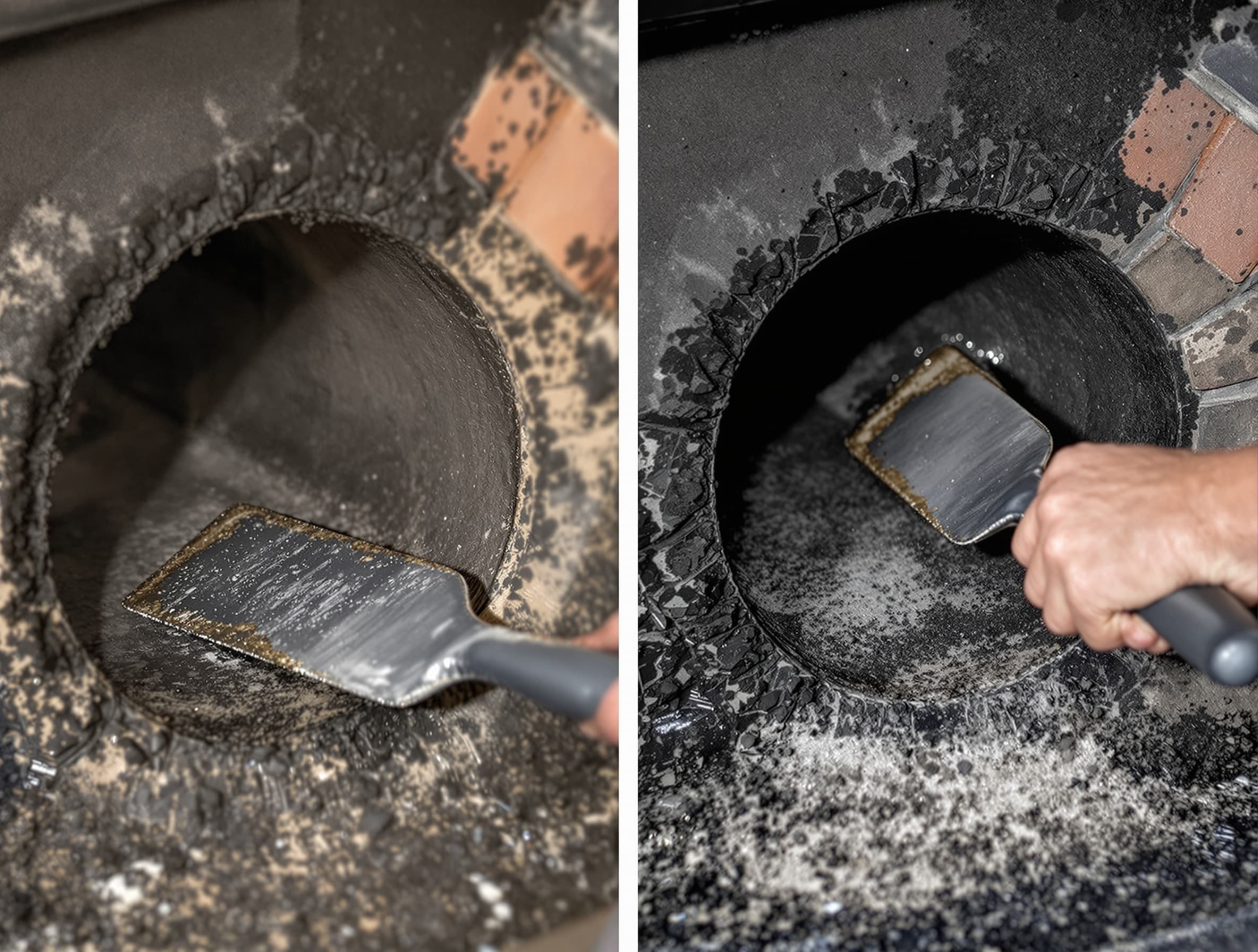
What it looks like: hard, flaky, tar-like. Often dark brown or shiny black. Won't brush off with a standard sweep — needs scraping or a chain rotor.
Why it forms: smoldering fires, wet wood, restricted air supply. Common in homes where the damper is left mostly closed to slow the burn.
Risk level: moderate. Stage 2 can ignite at around 2000°F, which is well within the range of a hot fire in the firebox below.
Stage 3: glazed creosote
What it looks like: hard, shiny, almost like dark taffy or black glass fused to the flue wall. You can't brush or scrape it off — it won't move.
Why it forms: years of Stage 2 that was never cleaned, combined with slow-burning wet wood fires. Seals into a layer that chemically bonds to the flue tile.
Risk level: high. Stage 3 is fuel. When it catches — and it does catch, usually from a spark or overfiring — you get a classic chimney fire: flames shooting 20 feet out of the chimney top, temperatures inside the flue reaching 2000-2500°F, and often cracked flue tiles once the fire is out.
The only safe removal for Stage 3 is a chemical treatment (potassium-based product applied over days of low fires to break the glaze down to Stage 2 texture) followed by a mechanical sweep. Attempting to grind it out with a power tool almost always cracks the flue tiles.
How Long Island homeowners end up with Stage 3
We see three patterns almost every time:
- "We only use the fireplace once or twice a year." That's enough to accumulate Stage 1 and 2 over 5-10 years. Without an annual sweep, it builds into Stage 3.
- Wet wood. Long Island summers are humid. Wood stored uncovered hits 25-30% moisture. That burns cold and smokes, which deposits creosote fast.
- Closed damper, slow fire. Homeowners trying to "make a log last" close the damper and choke the fire. Low oxygen = incomplete combustion = heavy creosote.
When to call for an emergency sweep
If you notice any of these, stop burning and schedule an inspection:
- Strong tar or campfire smell inside the home when the fireplace isn't in use
- Black streaking on the chimney exterior bricks above the crown
- A roaring sound from the flue during a fire (may indicate an active or smoldering chimney fire)
- A chimney fire you saw flames from the top (requires immediate Level II inspection before next use)
What we do on a Long Island sweep
For any chimney we service, the standard protocol is:
- Inspect with a chimney camera — photograph creosote stage, flue condition, and any cracks
- Sweep with a rotary head appropriate to the stage
- For Stage 2: mechanical scraping with chain rotor
- For Stage 3: recommend chemical treatment plan before a second-visit sweep
- Vacuum the hearth and smoke shelf, clean the firebox
Stage 1 sweeps are $249-$395 on Long Island. Stage 2 adds $75-$150 for extra time. Stage 3 requires a separate treatment plan and usually runs $450-$850 for the chemical phase plus a follow-up sweep.
The bottom line
If you burn more than a few fires a year, get an annual sweep. It's $249. A chimney fire costs $3,000-$15,000 in flue repairs plus smoke damage to the home. The math is simple.
We do around 1,200 annual chimney sweeps on Long Island between September and December. Book yours here — usually a 48-hour window.