# The terms get mixed up — here's what each actually means
When Long Island homeowners call asking for "tuckpointing," most of them actually want repointing. The two words get used interchangeably by contractors who don't know the difference, and customers end up paying for the wrong thing.
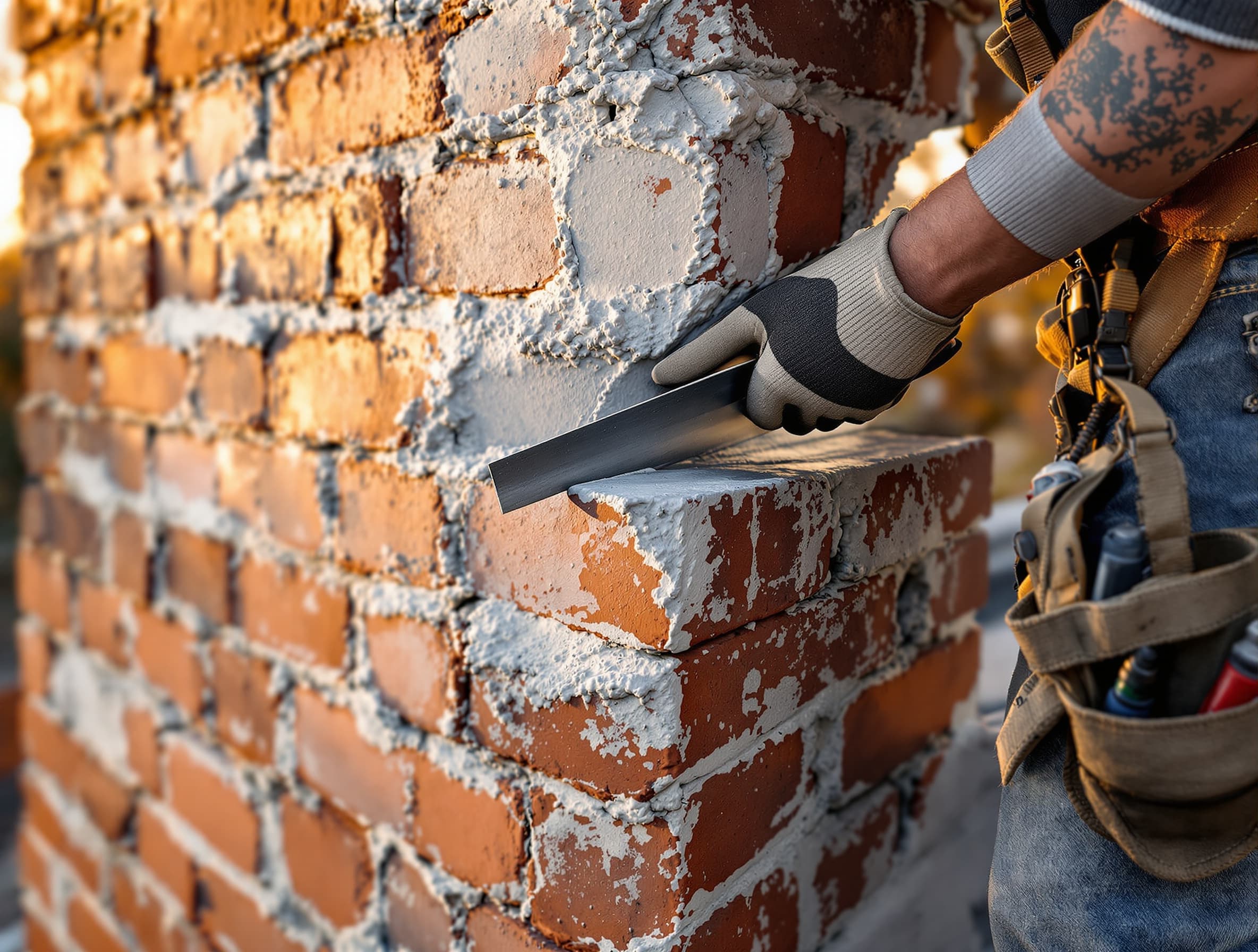
Repointing is the technical term for grinding out old deteriorated mortar joints on a brick chimney and replacing them with fresh mortar. This is what most Long Island chimneys need.
Tuckpointing is a specific 18th-century masonry technique where two colors of mortar are used — a base mortar that matches the brick color (hiding the joint) and a thin contrasting line (usually white lime) cut into the center to create the illusion of very thin, crisp joints. It's a decorative technique, mostly found on historic Federal and Georgian-style homes.
If your chimney is a standard red brick from the 1940s-80s (the Long Island majority), you need repointing. If your chimney is on a landmark-status Federal colonial in Oyster Bay or a historic restoration, you might actually need tuckpointing.
When to repoint a Long Island chimney
Brick mortar joints don't last forever. Long Island's freeze-thaw cycle is rough on masonry — we hit freezing 40-60 nights per winter, and every freeze cycle that hits a saturated joint pushes the mortar apart a little more. Signs your chimney needs repointing:
- You can stick a finger into a mortar joint and pull sand out
- Joints are recessed more than 3/8 inch from the brick face
- Visible horizontal cracks running through multiple bricks
- Loose or missing bricks on the exterior
- Brown or rust staining down the side of the chimney (water penetrating old joints and carrying iron)
If you've got even two of these, book an inspection. Failed mortar joints let water into the chimney structure, and water behind the brick in Long Island winters is how brick chimneys eventually topple.
The repointing process
For a standard Long Island chimney, Paul's crew follows this sequence:
- Grind. Old mortar is ground out to a depth of at least 3/4 inch — deeper than the defect. We use diamond blade angle grinders with dust extraction.
- Clean. Joints are vacuumed and rinsed. Any loose material is removed.
- Match mortar. We mix Type N mortar (standard for above-grade exterior chimneys) with a color match to the original joint. For chimneys pre-1940, we test with Type O (softer) since modern Type N mortar can be too hard and cause brick faces to spall.
- Point. Mortar is packed into the joints in two passes — first pass establishes contact with the brick, second pass brings the joint flush. Joints are struck (tooled) to match the original profile.
- Cure. Fresh mortar is kept damp for 48-72 hours in warm weather to prevent rapid drying and cracking.
What Long Island repointing costs
For a standard one-story chimney in average condition — 8 to 12 linear feet of joint — expect $900 to $1,800. Multi-story chimneys or chimneys with significant damage run $2,400 to $3,500. Full historic-accurate tuckpointing on a Federal or Georgian chimney (rare) can hit $4,500-$6,000.
These ranges include scaffolding, material, labor, and written warranty. Permit fees for Nassau County residential masonry work are usually not required for repointing (no structural change), but your specific situation may differ.
The warranty question
A properly-done Long Island repoint job should last 30-40 years. We warranty our repoint work for 5 years against mortar failure. If you see crumbling at any joint in the first 5 years, we come back and fix it free.
Watch out for contractors who warranty the work for 1 year or won't put the warranty in writing. Good mortar work survives. If a company is worried about guaranteeing it for 5 years, that tells you something.
When you genuinely need tuckpointing
If you own a historically-significant property in Oyster Bay, Sea Cliff, or Stony Brook — something pre-1850 — and you're restoring it to period-accurate condition, actual tuckpointing may be called for. This is specialty masonry work. Paul has done six true tuckpoint jobs in 25 years. The decorative joint technique is rare on Long Island.
For those jobs, we partner with a restoration mason out of Connecticut and the cost is roughly double standard repointing.
Book an inspection
Not sure what your chimney needs? Schedule a free estimate. Paul will come out, check the joint condition, photograph the wear pattern, and tell you exactly what's required. No upsell — if your joints have 15 years left in them, we'll say so and come back in 10 years.